
Technical Guide
Polyurethane (PU) Flooring & Coatings
A practical guide to polyurethane floor coatings from a Singapore manufacturer with more than 40 years of formulation experience — what PU coatings are, the systems we produce, how they pair with epoxy, and how to choose the right one for your environment.
Last updated: 5 July 2026
What is polyurethane (PU) flooring?
Polyurethane flooring is a resin floor or coating system based on polyurethane chemistry, valued for abrasion resistance, flexibility, and colour and gloss retention — including non-yellowing performance under UV when aliphatic grades are used. Where epoxy provides a floor's hardness and build, polyurethane typically provides the wearing surface: the topcoat that takes the traffic, sunlight and cleaning.
PU systems come in several forms: solvent-based two-component topcoats, water-based polyurethane dispersions (PUD) for low-odour application in occupied spaces, single-component self-crosslinking hybrids, heavy-duty polyurethane screeds, and two-component (2K) clear lacquers for automotive refinishing. Sparco manufactures all of these in Singapore.
Types of PU systems Sparco manufactures
Every system below is formulated and produced by Sparco in Singapore. Each product links to its page, where the Technical Data Sheet (TDS) can be downloaded.
Solvent-based PU floor topcoats
Two-component solvent-based polyurethane finishes for floors that must keep their colour and gloss. Sparcofloor PU 41 is a solvent-based aliphatic polyurethane coating with excellent abrasion resistance and non-yellowing performance; Sparcofloor 343 is a two-component solvent-based polyurethane floor coating that retains its colour and high gloss under strong ultraviolet exposure — a common topcoat for exposed car park decks and zone demarcation.
Related Sparco products
Water-based PUD coatings
Water-based polyurethane dispersion (PUD) systems apply with low odour, suiting occupied or sensitive environments. Sparcothane 341W is a two-component water-based aliphatic PUD with excellent abrasion resistance and durability; Sparcothane 910 is a water-based aliphatic PUD with excellent abrasion resistance and non-yellowing performance.
Related Sparco products
Single-component hybrid urethane
Sparco Hybrid Urethane is a single-component, self-crosslinking acrylic-copolymer-enhanced polyurethane with excellent water resistance — a practical low-odour option where two-component mixing is impractical.
Related Sparco products
Polyurethane screed
For heavy-duty floors, Sparco 3-C Polyurethane Screed is a water-based, self-smoothing hybrid polyurethane screed for medium to heavy duty service — specified in food and beverage plants, chemical processing areas and other demanding environments.
Related Sparco products
Water-based aliphatic urethane topcoat
EcoTough Floor Topcoat is an eco-friendly, two-component water-based aliphatic urethane coating used as the wearing coat of the EcoTough floor system over its acrylic primer.
Related Sparco products
2K automotive clear lacquers
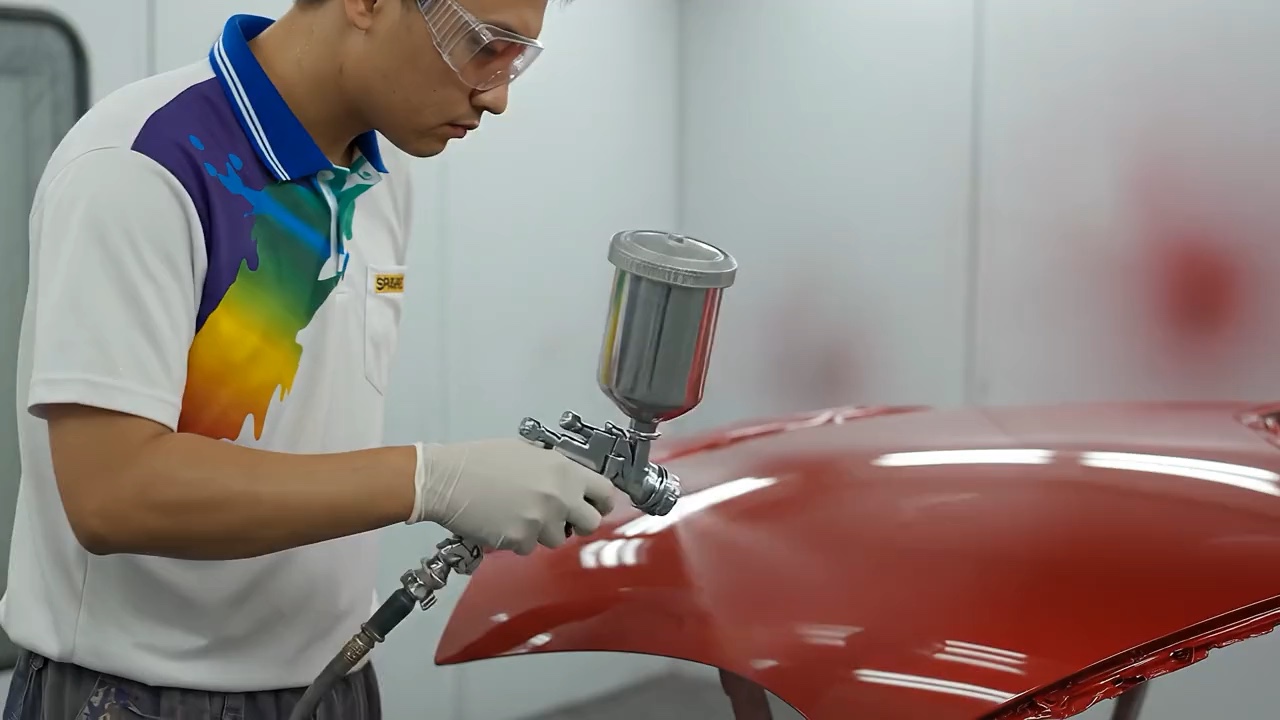
Sparco's polyurethane chemistry extends to automotive refinishing: three two-component polyurethane acrylic clear lacquers — standard, fast-dry 741-300 and MS 2600 — formulated as topcoats for automobiles and commercial vehicles with gloss, solvent and weather resistance.
Related Sparco products
PU vs epoxy: which do you need?
Usually both. Epoxy and polyurethane play different roles in the same floor: epoxy delivers hardness, build and chemical resistance in the body of the system, while polyurethane delivers the abrasion-resistant, UV-stable finish at the surface. A typical exposed floor is an epoxy body coat finished with an aliphatic PU topcoat. For the full epoxy side of the comparison, see our epoxy flooring guide.
| Polyurethane (PU) | Epoxy | |
|---|---|---|
| Best for | Topcoats, UV-exposed decks, colour-critical and decorative finishes | Floor body, high build, heavy chemical exposure |
| Key strengths | Abrasion resistance, flexibility, non-yellowing gloss and colour retention | Hardness, mechanical strength, chemical resistance |
| Application forms | Solvent-based or water-based (PUD), 1K or 2K, screeds | Solvent-free, water-based, self-smoothing, roller coats |
| Sparco examples | Sparcofloor PU 41, Sparcofloor 343, Sparcothane 341W/910, 3-C PUR Screed | Sparcofloor SL 200, Sparcofloor #102, WBE 400/410 |
Read the companion guide for the epoxy side of the system: Epoxy Flooring Guide →
Where PU fits in a floor system
Polyurethane products typically take one of three roles in a Sparco floor build-up:
UV-stable topcoat
Over an epoxy body coat on exposed decks, ramps and colour-coded zones — aliphatic PU grades such as Sparcofloor PU 41 and Sparcofloor 343 keep colour and gloss where epoxy alone would discolour.
Low-odour wearing coat
Water-based PUD coatings such as Sparcothane 341W and 910 serve occupied environments — schools, offices, retail — where solvent odour is unacceptable during application.
Heavy-duty screed
Sparco 3-C Polyurethane Screed forms the whole wearing body of the floor in demanding wet-process and industrial environments.
System selection depends on substrate, exposure and traffic. Sparco's technical team recommends complete build-ups, not just single products.
Where PU systems are used
Polyurethane coatings appear across Sparco's market segments — most intensively in:
Car Park
UV-stable PU topcoats over epoxy deck systems on exposed decks and ramps.
Education
Low-odour water-based PUD and urethane systems for classrooms, halls and walkways.
Office
Water-based PU wearing coats with predictable maintenance and a professional finish.
Food & Beverages
Polyurethane screeds for washdown-tolerant, seamless process floors.
Automotive
2K polyurethane acrylic clear lacquers for professional refinishing.
Sports
Comfortable, weather-stable coated surfaces for courts and recreation areas.
How to choose the right PU system
Four questions decide the specification: Is the floor exposed to sunlight (aliphatic, non-yellowing grades matter)? Is the space occupied during application (water-based PUD favours low odour)? What traffic and cleaning must the surface survive (abrasion resistance and screed thickness)? And is the PU a topcoat over epoxy or the whole system (screed)?
Share your environment and substrate details through our enquiry form and Sparco's technical team will recommend a suitable system and build-up, with Technical Data Sheets to support specification — at no obligation.
PU flooring questions
Does polyurethane flooring yellow in sunlight?
Aliphatic polyurethane grades do not. Sparco's aliphatic PU coatings — Sparcofloor PU 41, Sparcothane 341W and Sparcothane 910 — are formulated for non-yellowing colour and gloss retention, which is why aliphatic PU is the standard topcoat for UV-exposed decks.
What is a water-based PUD coating?
PUD stands for polyurethane dispersion — polyurethane carried in water rather than solvent. Water-based PUD coatings such as Sparcothane 341W and Sparcothane 910 apply with low odour, making them suitable for occupied buildings, and offer excellent abrasion resistance once cured.
Can PU be applied directly over concrete?
PU wearing coats are normally applied over a primer or epoxy body coat that seals and bonds to the concrete. In the EcoTough system, for example, the water-based acrylic primer prepares the substrate for the EcoTough water-based aliphatic urethane topcoat. Sparco recommends complete build-ups matched to the substrate.
What is a polyurethane screed?
A polyurethane screed is a thick, trowel- or flow-applied PU floor that forms the entire wearing body rather than a thin coating. Sparco 3-C Polyurethane Screed is a water-based, self-smoothing hybrid screed for medium to heavy duty floors in demanding environments such as food production.
Specifying a PU floor or topcoat?
Tell us your environment, exposure and substrate condition, and our technical team will recommend a system and provide a quotation.